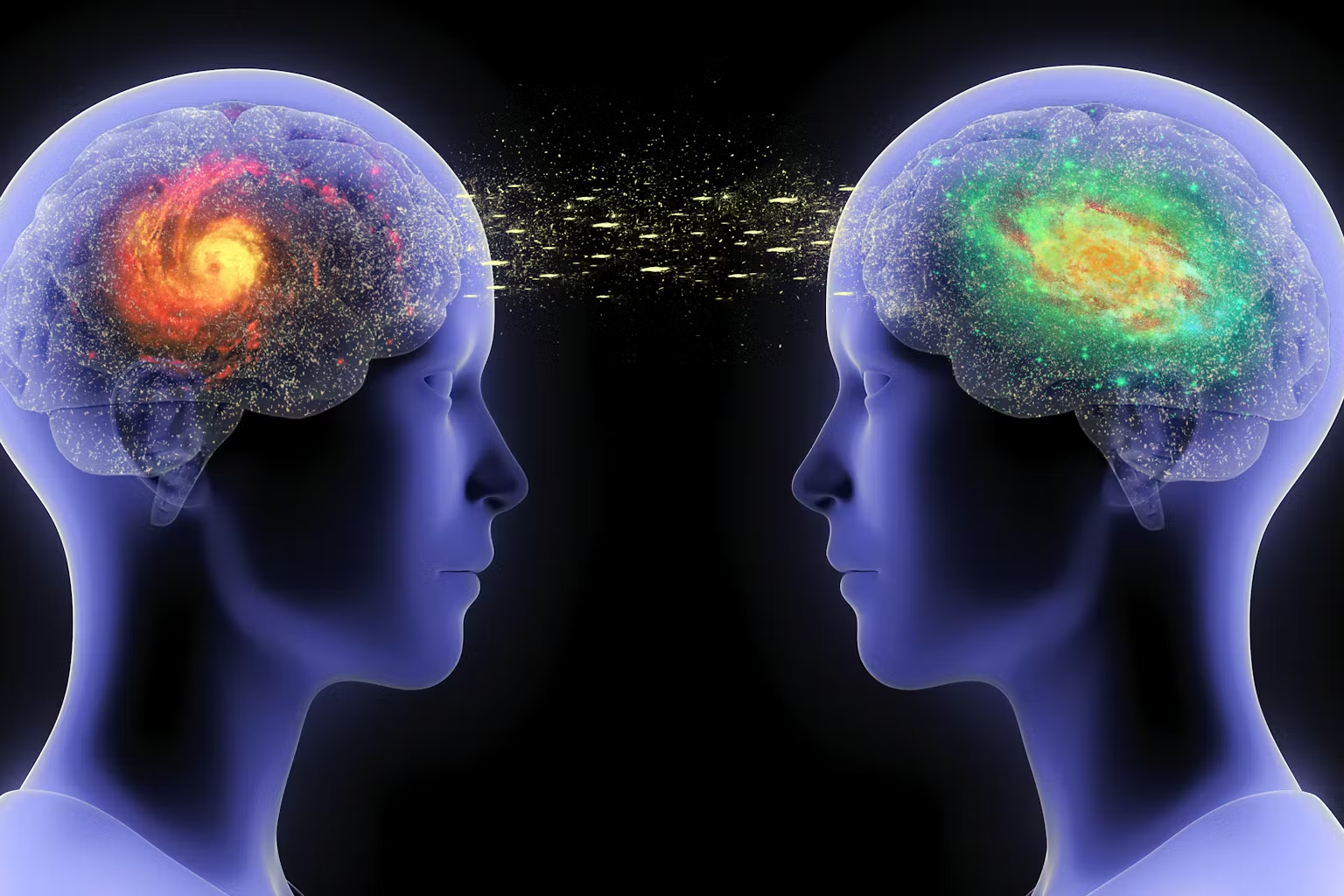
What if an AI could peek into your thoughts—not literally, but close enough to feel like magic? That’s exactly what’s happening with cutting-edge brain-computer interface (BCI) technology and advanced AI models that interpret neural signals. While we’re not quite at the stage of mind-reading robots from sci-fi movies, recent breakthroughs have brought us startlingly close. This AI tool reads your mind—sort of—by decoding brain activity into words, images, or commands using machine learning and real-time neural data. It’s not telepathy, but it might as well be.
Imagine thinking about a sentence, and seconds later, it appears on a screen—no typing, no voice. Or picturing a red apple in your head, and an AI reconstructing that image from your brainwaves. These aren’t scenes from a futuristic film; they’re real experiments happening in labs today. Companies like Neuralink, Meta, and academic researchers at institutions such as UC Berkeley and MIT are pushing the boundaries of what AI and neuroscience can achieve together.
The key lies in combining electroencephalography (EEG), functional MRI (fMRI), or implanted electrodes with deep learning algorithms. These systems don’t “read thoughts” in the traditional sense—they interpret patterns of brain activity associated with specific intentions, memories, or sensory experiences. While still in early stages, the implications are enormous: from helping paralyzed individuals communicate to revolutionizing how we interact with technology.
How Does This AI Tool Actually Work?
At its core, this AI tool reads your mind by translating electrical or metabolic brain signals into meaningful output. The process involves three main stages: data collection, signal processing, and AI interpretation.
First, sensors capture brain activity. Non-invasive methods like EEG headsets record electrical impulses from the scalp, while fMRI machines track blood flow changes in the brain. More advanced setups use implanted electrodes for higher precision. These tools generate massive datasets of neural patterns linked to specific thoughts, emotions, or actions.
Next, signal processing cleans and filters the raw data. Brain signals are noisy and complex, so algorithms remove artifacts like muscle movements or environmental interference. This step ensures only relevant neural information reaches the AI model.
Finally, machine learning models—often based on neural networks—analyze the processed signals. Trained on thousands of examples, these AI systems learn to associate certain brain patterns with words, images, or intentions. For instance, when you imagine saying “hello,” your brain produces a unique activation pattern. The AI recognizes this pattern and outputs the word “hello” on a screen.
Types of Brain Data Used
- EEG (Electroencephalography): Measures electrical activity via scalp electrodes. Portable and affordable, but lower spatial resolution.
- fMRI (Functional Magnetic Resonance Imaging): Tracks blood oxygenation changes. Offers high spatial detail but is expensive and not portable.
- ECoG (Electrocorticography): Uses implanted electrodes on the brain’s surface. High signal quality, used in clinical settings.
- Intracortical Implants: Microelectrodes inserted into brain tissue. Highest precision, used in experimental therapies.
Real-World Examples of Mind-Reading AI
Several groundbreaking projects demonstrate how this AI tool reads your mind in practical scenarios. One of the most notable comes from researchers at the University of Texas at Austin. In 2023, they developed a non-invasive system that reconstructs spoken sentences from brain activity using fMRI and AI.
Participants listened to stories while inside an MRI scanner. The AI model analyzed their brain responses and generated text that closely matched the original narrative—sometimes word-for-word. The system didn’t require invasive surgery, making it a promising step toward accessible mind-reading tech.
Another breakthrough came from a team at Columbia University. They used AI to reconstruct images seen by participants based solely on fMRI data. When shown a picture of a face, the AI could generate a rough but recognizable version of that face by interpreting neural patterns in the visual cortex.
Even more astonishing is the work by Stanford scientists who enabled a paralyzed man to type at 90 characters per minute just by imagining writing letters. Using an implanted BCI and a custom AI decoder, the system translated his intended handwriting movements into text on a screen—faster than any previous method.
Applications Beyond Communication
- Medical Rehabilitation: Helping stroke or ALS patients regain communication abilities.
- Mental Health Monitoring: Detecting early signs of depression or anxiety through brain pattern analysis.
- Enhanced Learning: Tailoring educational content based on real-time cognitive engagement.
- Gaming & VR: Controlling virtual environments with thought alone.
- Security & Authentication: Using brainwave patterns as biometric passwords.
The Technology Behind the Magic: AI Meets Neuroscience
What makes this AI tool so powerful is the fusion of artificial intelligence and neuroscience. Traditional brain-computer interfaces relied on simple signal mapping—like associating a specific brain wave with a cursor movement. But modern systems use deep learning to uncover complex, nonlinear relationships in neural data.
Convolutional neural networks (CNNs), originally designed for image recognition, are now being adapted to analyze brain scans. Recurrent neural networks (RNNs) and transformers—the same architecture behind ChatGPT—help decode sequences of thoughts, such as sentences or imagined actions.
Training these models requires massive datasets. Researchers collect brain recordings from volunteers performing specific tasks: listening to music, viewing images, or thinking about actions. The AI learns to generalize from these examples, eventually predicting thoughts from new, unseen brain activity.
One major challenge is individual variability. Every brain is wired differently, so a model trained on one person may not work for another. To address this, some systems use transfer learning—fine-tuning a general model with a small amount of personalized data.
Key AI Techniques Used
- Deep Neural Networks: For pattern recognition in high-dimensional brain data.
- Natural Language Processing (NLP): To convert neural signals into coherent text.
- Generative AI: For reconstructing images or sounds from brain activity.
- Reinforcement Learning: To improve BCI performance through user feedback.
Ethical Concerns: Can AI Really Read Your Thoughts?
With great power comes great responsibility—and this AI tool raises serious ethical questions. If machines can interpret brain activity, who controls that data? Could governments or corporations misuse it for surveillance or manipulation?
Privacy is a major concern. Brain data is arguably the most personal information a person can have. Unlike passwords or fingerprints, thoughts are deeply private. Yet, current regulations lag behind the technology. Most countries lack specific laws governing neural data, leaving a legal gray area.
There’s also the risk of “cognitive hacking.” Imagine an app that subtly influences your decisions by detecting your emotional state and feeding you targeted content. Or a malicious actor accessing your implanted BCI to steal thoughts or implant false memories.
Moreover, the technology could deepen social inequalities. High-end BCIs may only be accessible to the wealthy, creating a “neuro-divide” between those who can enhance their cognition and those who cannot.
Key Ethical Issues to Consider
- Consent: How do we ensure informed consent for brain data collection?
- Data Ownership: Who owns your neural data—you, the company, or the researcher?
- Mental Privacy: Should there be a “right to cognitive liberty”?
- Bias & Discrimination: Could AI misinterpret thoughts based on cultural or neurological differences?
- Autonomy: What happens if AI starts predicting or influencing decisions before you’re aware of them?
The Future: Will AI Truly Read Our Minds?
The idea of a fully mind-reading AI remains speculative—but not impossible. Experts predict that within the next decade, we’ll see consumer-grade devices that allow basic thought-to-text or thought-to-command functions. Think typing emails by thinking, or controlling smart home devices with your mind.
Long-term, the goal is seamless human-AI symbiosis. Imagine uploading knowledge directly to your brain, or sharing memories with others like digital photos. Some futurists even envision “collective intelligence,” where groups of minds are linked via AI networks.
However, technical hurdles remain. Current systems require extensive calibration and are limited to simple tasks. Decoding abstract thoughts—like emotions or creativity—is far more complex. And non-invasive methods still lack the precision of implants.
Still, progress is accelerating. With advances in AI, materials science, and neuroscience, the line between thought and machine is blurring faster than ever.
Key Takeaways
- This AI tool reads your mind by interpreting brain signals using machine learning and neurotechnology.
- It works by capturing neural data (via EEG, fMRI, or implants), processing it, and using AI to decode thoughts into text, images, or commands.
- Real-world applications include helping paralyzed individuals communicate, reconstructing images from brain activity, and enabling thought-controlled typing.
- Ethical concerns include privacy, data ownership, cognitive hacking, and potential misuse by governments or corporations.
- The future holds promise for consumer mind-reading devices, but technical and ethical challenges must be addressed.
FAQ
Can AI really read my thoughts right now?
Not in the way movies portray it. Current AI tools can interpret specific brain patterns linked to words, images, or simple intentions—but not abstract or private thoughts. The technology is still experimental and limited to controlled environments.
Is mind-reading AI safe?
Safety depends on the method. Non-invasive tools like EEG headsets are generally safe, while implanted devices carry surgical risks. The bigger concern is data security—ensuring your brain data isn’t hacked or misused.
Will mind-reading AI be available to the public soon?
Basic versions may arrive in the next 5–10 years, especially for medical or accessibility purposes. Consumer-grade devices for everyday use are further off and will require significant advances in accuracy, affordability, and regulation.
Final Thoughts
This AI tool reads your mind—sort of—by bridging the gap between human cognition and machine intelligence. It’s not magic, but it’s close. As the technology evolves, it promises to transform healthcare, communication, and human-computer interaction. But with great innovation comes great responsibility. We must ensure that as we unlock the secrets of the mind, we also protect the privacy, autonomy, and dignity of every individual. The future of mind-reading AI isn’t just about what machines can do—it’s about what we choose to let them do.