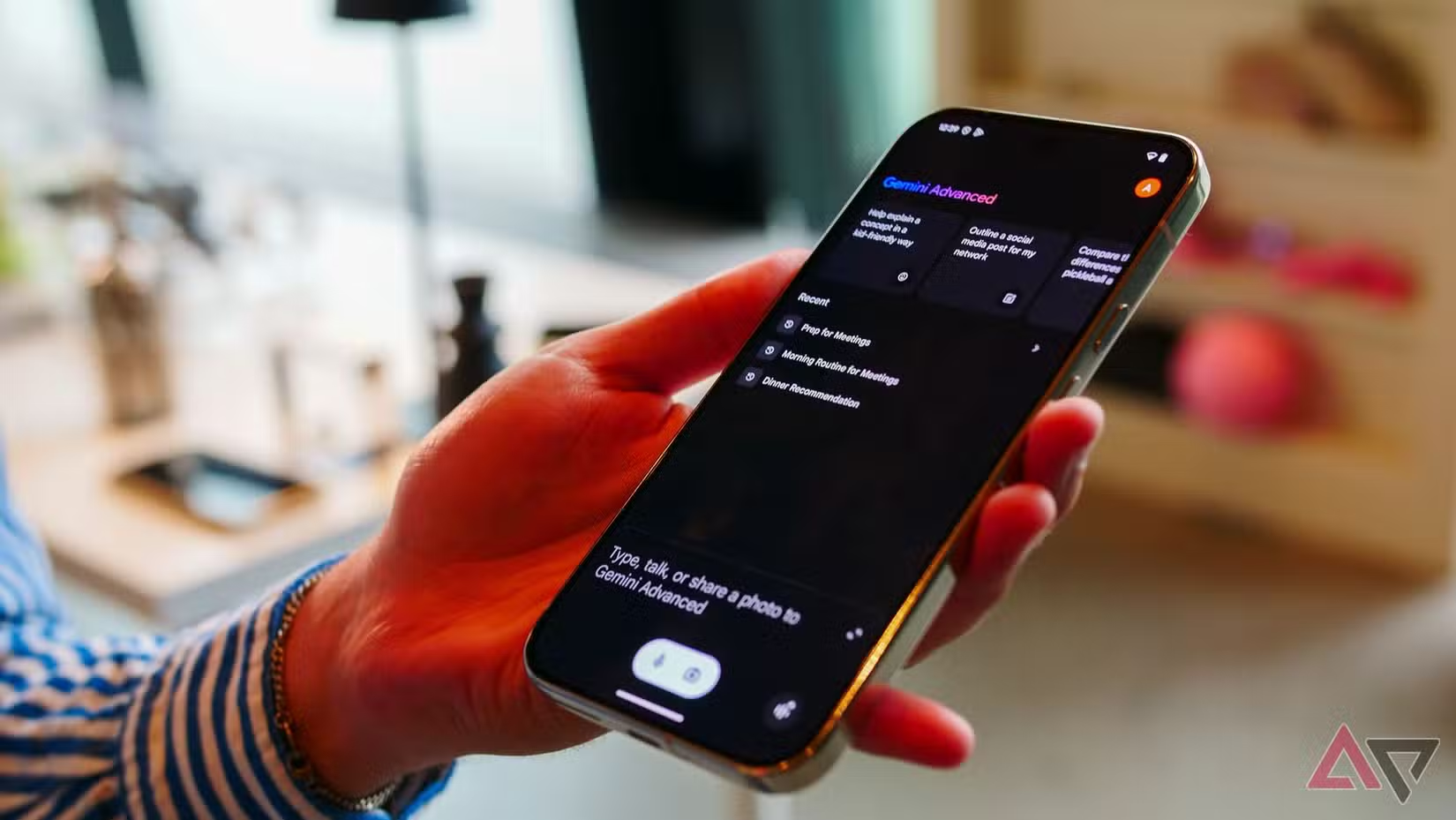
What if I told you that the device you check for weather updates, scroll through social media, or use to video call your family is actually more powerful than the computers that sent humans to the moon? It’s true. Your smartphone is a supercomputer—compact, energy-efficient, and capable of performing billions of calculations per second. Gone are the days when supercomputers were massive machines housed in climate-controlled rooms. Today, that level of computing power fits snugly in your palm.
This isn’t just a metaphor. Modern smartphones rival early supercomputers in processing speed, memory capacity, and multitasking ability. With advanced chipsets, AI accelerators, and high-bandwidth connectivity, your phone isn’t just a communication tool—it’s a personal supercomputer redefining what’s possible in daily life. From real-time language translation to augmented reality navigation, the capabilities are staggering. And the best part? It’s always with you.
In this article, we’ll explore how your smartphone evolved into a supercomputer, what makes it so powerful, and how this shift is transforming industries, education, healthcare, and entertainment. You’ll discover the hidden tech under the glass and metal, and why understanding this evolution matters more than ever.
How Did Your Smartphone Become a Supercomputer?
The journey from flip phones to pocket-sized supercomputers has been nothing short of revolutionary. Just two decades ago, mobile devices were limited to calls, texts, and basic games. Today, they pack more computing muscle than NASA had during the Apollo 11 mission in 1969.
So, what changed? The answer lies in rapid advancements in semiconductor technology, miniaturization, and software optimization. Moore’s Law—the observation that the number of transistors on a microchip doubles approximately every two years—has driven exponential growth in processing power while shrinking device size.
Modern smartphones now feature multi-core processors, often with dedicated AI chips (like Apple’s Neural Engine or Google’s Tensor), high-speed RAM, and ultra-fast storage. These components work in harmony to deliver desktop-level performance. For example, the Apple A17 Pro chip in the iPhone 15 Pro can perform over 35 trillion operations per second—more than many supercomputers from the early 2000s.
The Role of AI and Machine Learning
One of the biggest leaps in smartphone intelligence comes from artificial intelligence (AI) and machine learning (ML). Your phone doesn’t just run apps—it learns from you. It recognizes your face, predicts your next text, enhances photos in real time, and even detects health anomalies through sensors.
AI chips are designed specifically to handle complex algorithms efficiently. They enable features like:
- Real-time language translation (e.g., Google Translate)
- Voice assistants (Siri, Google Assistant, Bixby)
- Smart camera modes (night mode, portrait blur, HDR)
- Predictive text and autocorrect
- On-device privacy protection (processing data locally instead of sending it to the cloud)
This shift to on-device AI means faster responses, better privacy, and reduced reliance on internet connectivity—making your smartphone not just smart, but truly autonomous.
Processing Power: More Than Just Speed
When we talk about your smartphone being a supercomputer, processing power is the foundation. But it’s not just about clock speed (measured in GHz). It’s about how efficiently the chip handles multiple tasks simultaneously.
Modern smartphones use system-on-a-chip (SoC) designs, integrating the CPU, GPU, modem, AI engine, and more into a single package. This integration reduces power consumption and increases performance. For instance, Qualcomm’s Snapdragon 8 Gen 3 and Apple’s A17 Pro are built on 4nm and 3nm process nodes, respectively—meaning transistors are so small, thousands can fit on the tip of a needle.
To put this in perspective:
- The iPhone 15 Pro’s A17 Pro chip delivers up to 10% faster CPU performance and 20% faster GPU performance than its predecessor.
- The Samsung Galaxy S24 Ultra, powered by the Snapdragon 8 Gen 3, can render 4K video, run AI models, and stream high-fidelity games—all while maintaining battery life.
- Benchmark tests show that flagship smartphones now outperform many mid-range laptops in tasks like image processing and multitasking.
This level of performance enables complex applications that were once exclusive to high-end computers. Think 3D modeling, video editing, and even scientific simulations—all happening on your phone.
Memory and Storage: The Brain’s Capacity
A supercomputer needs more than a fast processor—it needs memory (RAM) and storage to handle large datasets. Today’s smartphones offer up to 16GB of RAM and 1TB of internal storage, rivaling many laptops.
High RAM allows your phone to run multiple apps in the background without slowing down. Whether you’re gaming, streaming, or using productivity tools, your phone keeps everything ready at a moment’s notice.
Meanwhile, UFS (Universal Flash Storage) 4.0 technology delivers read speeds of over 4,000 MB/s—faster than some SSDs. This means apps launch instantly, photos save in a blink, and large files transfer in seconds.
Combined with cloud integration, your smartphone becomes a seamless extension of your digital life, storing everything from family photos to work documents with instant access.
Connectivity: The Nervous System of Your Supercomputer
No supercomputer operates in isolation. Your smartphone’s connectivity options—5G, Wi-Fi 6E, Bluetooth 5.3, and NFC—form its nervous system, enabling rapid data exchange with the world.
5G networks offer speeds up to 100 times faster than 4G, allowing you to download a full HD movie in under 30 seconds. This isn’t just for streaming—it enables real-time collaboration, cloud gaming, and remote work with near-zero latency.
Wi-Fi 6E expands bandwidth and reduces interference, making your home network faster and more reliable. Bluetooth 5.3 improves audio quality and device pairing, while NFC powers contactless payments and smart home controls.
Together, these technologies ensure your smartphone stays connected, responsive, and ready to act—whether you’re in a subway tunnel or a remote mountain cabin.
Edge Computing: Intelligence at the Source
One of the most exciting developments is edge computing—processing data directly on the device instead of relying on distant servers. This reduces latency, saves bandwidth, and enhances privacy.
Your smartphone now handles tasks like:
- Voice recognition (e.g., “Hey Siri”)
- Facial recognition for unlocking
- Real-time photo enhancement
- Health monitoring (heart rate, sleep tracking)
By keeping sensitive data on-device, edge computing makes your smartphone not just faster, but safer. It’s a key reason why your phone can act like a personal assistant, doctor, and security system—all at once.
Real-World Applications: Your Supercomputer in Action
The true power of your smartphone as a supercomputer isn’t just in specs—it’s in what it enables you to do every day. Let’s explore some real-world applications that showcase its capabilities.
Healthcare and Wellness
Your smartphone is becoming a personal health hub. With built-in sensors and AI, it can monitor heart rate, blood oxygen, sleep patterns, and even detect irregular heart rhythms (like atrial fibrillation).
Apps like Apple Health and Google Fit aggregate data from wearables and medical devices, providing insights that were once only available in clinics. Some smartphones now support ECG readings, blood glucose monitoring (via external sensors), and fall detection—potentially saving lives.
In remote areas, smartphones enable telemedicine, allowing patients to consult doctors via video call and share diagnostic data in real time. This democratizes healthcare, bringing expert care to underserved communities.
Education and Learning
Imagine a classroom where every student has access to a supercomputer. That’s the reality today. Smartphones support interactive learning apps, virtual labs, language learning tools, and augmented reality textbooks.
Students can use their phones to:
- Scan objects for 3D models (via AR)
- Translate foreign texts instantly
- Record and analyze science experiments
- Access online courses and digital libraries
For children in developing regions, a smartphone can be a gateway to education—offering free resources, tutoring apps, and global connectivity.
Creative Expression and Productivity
Artists, writers, and professionals are using smartphones as powerful creative tools. With apps like Procreate Pocket, LumaFusion, and Adobe Photoshop Express, you can paint, edit videos, and design graphics on the go.
Smartphones now support:
- 4K video recording with cinematic modes
- Professional-grade photo editing
- Music production with MIDI support
- Document scanning and PDF creation
Entrepreneurs use their phones to manage businesses—tracking inventory, processing payments, and communicating with teams. Your smartphone is no longer just a tool—it’s a studio, office, and gallery all in one.
The Environmental and Ethical Side of Pocket Supercomputers
While the benefits are clear, the rise of smartphone supercomputers also raises important questions about sustainability and ethics.
Smartphones require rare earth metals, energy-intensive manufacturing, and contribute to e-waste. The average user upgrades their phone every 2–3 years, leading to millions of discarded devices annually.
However, companies are responding. Apple, for example, uses 100% recycled cobalt in its batteries and aims for carbon neutrality by 2030. Google and Samsung have introduced repair programs and modular designs to extend device lifespans.
Ethically, the power of on-device AI brings concerns about surveillance, data privacy, and digital addiction. As your smartphone becomes smarter, it’s crucial to use it mindfully—setting boundaries, protecting personal data, and staying informed about how your data is used.
The future of smartphone supercomputers must balance innovation with responsibility—ensuring technology serves humanity, not the other way around.
Key Takeaways: Why Your Smartphone is a Supercomputer
- Your smartphone is a supercomputer—it outperforms early supercomputers in speed, efficiency, and functionality.
- Advanced chipsets, AI engines, and high-speed memory enable desktop-level performance in a pocket-sized device.
- Real-world applications span healthcare, education, creativity, and productivity—transforming how we live and work.
- Edge computing and 5G connectivity make your phone faster, smarter, and more responsive than ever.
- Sustainability and ethics must guide future innovation to ensure technology benefits everyone.
FAQ: Your Smartphone as a Supercomputer
Is my smartphone really as powerful as a supercomputer?
Yes—in terms of raw processing power, many modern smartphones surpass supercomputers from the 1990s and early 2000s. While they don’t match today’s largest supercomputers (like Frontier or Fugaku), they deliver comparable performance for everyday tasks and specialized applications.
What makes a smartphone a “supercomputer” and not just a phone?
It’s the combination of high-performance processors, AI acceleration, large memory, fast storage, and advanced connectivity. These components allow your phone to perform complex computations, run intelligent apps, and handle multiple tasks simultaneously—just like a supercomputer.
Can I use my smartphone for serious work or creative projects?
Absolutely. With the right apps and accessories, your smartphone can replace a laptop for many tasks. You can edit videos, design graphics, write documents, manage finances, and even code—all from your pocket supercomputer.
The Future is in Your Pocket
The idea that your smartphone is a supercomputer isn’t science fiction—it’s reality. Every time you unlock your phone, take a photo, or ask your assistant a question, you’re tapping into computational power that was unimaginable just a few decades ago.
As technology advances, this trend will only accelerate. Foldable screens, brain-computer interfaces, and quantum-inspired chips may soon redefine what a smartphone can do. But the core truth remains: the most powerful computer you’ll ever own fits in your hand.
So the next time you glance at your phone, remember—you’re not just holding a device. You’re holding a supercomputer, a personal assistant, a creative studio, and a gateway to the future. And it’s only getting smarter.